
Actuarial Insights from Dubai
A conversation with Owais Ansari, FSA, on thinking globally and acting locally
November 2025Photo: Trevor Brown
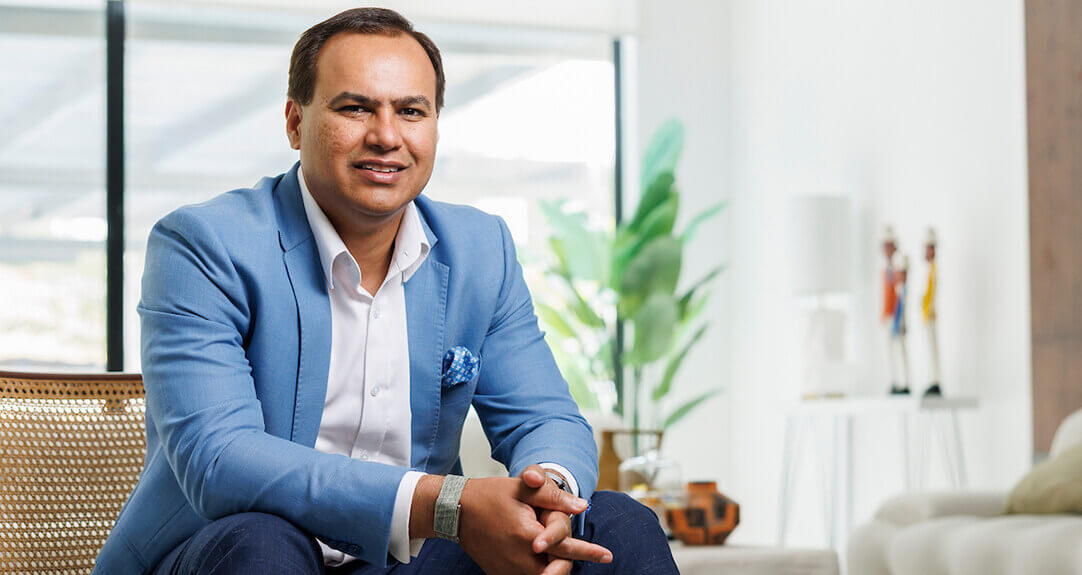
For The Actuary’s November issue, I’m pleased to share the story of Owais Ansari, FSA, Dubai-based CEO with Munich Re for the Middle East and North Africa (MENA) region, Pakistan, and Takaful markets.
For Owais, actuarial science wasn’t just a career choice—it has become a lifelong passion for solving complex problems and contributing meaningfully to society. In this Q&A, he details how his varied work experience and regional exposure have shaped his ability to connect global best practices with local realities, ensuring relevance and innovation.
What can you tell us about your educational background in Pakistan and your journey to becoming an actuary? What led you to pursue a career in actuarial science and insurance?
Owais Ansari: I completed my initial education in Karachi. Mathematics and statistics always fascinated me, and I was drawn to problem-solving. My father is from an insurance background as well, so he was my inspiration and the one who encouraged me to pursue actuarial science. Hence, I had selected the subjects in my high school (A Levels) that were best suited for the actuarial profession.
Universities in Pakistan did not have actuarial programs then (1998); therefore, post A Levels, I had the possibility to either go for a bachelor’s in actuarial science abroad or stay in Pakistan and join one of the few insurance or consulting firms that offered actuarial support programs. I joined Sidat Hyder Morshed Associates (member firm of Ernst and Young at that time, 1999) and commenced my professional and actuarial career.
Actuarial science captivated me with its unique blend of analytics, finance and risk management. I was particularly drawn to the insurance sector, where technical rigor meets meaningful social impact—helping individuals navigate life’s uncertainties. As I progressed through the actuarial exams, I came to appreciate the discipline’s depth and its global significance. My first professional experience introduced me to pensions and life insurance, laying a strong foundation for my eventual specialization. Over time, actuarial science evolved from a career choice into a lifelong passion, driven by the challenge of solving complex problems and the opportunity to contribute meaningfully to society.
Video Exclusive: Owais Talks About His Experiences in the Actuarial Profession
Reflecting on your roots in Pakistan, how have your early experiences influenced your approach to leadership in the global insurance and reinsurance industry?
Owais: Pakistan of yesteryear was an easier place to live compared to the situation today. Growing up in Pakistan with a well-knit family and social connections helped shape my core values: humility, perseverance and adaptability. These values have guided my leadership approach as I’ve navigated diverse markets and cultures.
From a professional perspective, it was a mixed bag. Two key advantages were getting exposed to a variety of work due to a lack of actuarial resources, and having the opportunity to work with and learn from senior actuaries due to the small team size within the actuarial firm.
On the other hand, the main downside was working in a less developed market and regulatory regime (especially the asset side). Fortunately, this has changed significantly and nowadays Pakistan increasingly offers interesting business opportunities for insurers.
Working in Pakistan taught me to be solution-oriented and resilient, shaped by resource constraints that demanded creativity and perseverance. What propelled me forward in the global insurance and reinsurance industry was a strong drive to grow and take on new responsibilities. Navigating cross-border insurance/reinsurance strategies requires a careful balance between local sensitivities and global priorities. My Pakistani roots instilled resilience and empathy—qualities that have been invaluable in leading multicultural teams and fostering collaboration across geographies.
What challenges have you faced in your current position leading Munich Re’s operations in the MENA region, and how have you overcome them?
Owais: In my current role within Munich Re in the MENA region, in addition to the reinsurance business, I am also responsible for a regional medical TPA, a technology firm specializing in health insurance solutions and a Retakaful entity. I work with a very competent team and have access to knowledge and resources from within the Munich Re Group. The MENA region is incredibly diverse, with unique customer needs, cultural expectations, and regulatory environments.
Navigating the (re)insurance business in the MENA region presents unique challenges shaped by political instability, which remain key considerations for any multinational operating here. UAE and Saudi Arabia drive the growth and development of the insurance sector within the region. Regulatory frameworks vary widely across markets, often requiring agility and deep local understanding—especially in areas with low insurance penetration. Building trust and awareness, particularly around life insurance, is an ongoing effort. Talent development in emerging markets is critical, and investing in upskilling local professionals has been a strategic priority to strengthen regional capabilities. To drive sustainable growth, it’s essential to go beyond traditional reinsurance solutions by embedding innovation and efficiency through digital portfolio enhancements. Ultimately, combining global expertise with a deep respect for local dynamics enables professionals to navigate complexity and become trusted partners in the region.
You’ve specialized in life and health insurance, especially Takaful. Can you tell us about your actuarial exposures across Pakistan, the Middle East and Europe?
Owais: I’ve had the good fortune of working in a variety of roles, including consultancy, regulator, insurer, Takaful startup and reinsurer. What has added value to the work experience is working in different geographies within South Asia, the Middle East, and Europe, giving me both technical depth and strategic breadth.
The diverse regions and various roles I held each offered unique learning experiences. In Pakistan, I began with foundational life insurance work and gained early hands-on experience in team management. Transitioning to the Middle East, I specialized in Takaful, where I balanced technical actuarial frameworks with Sharia-compliant product development in a rapidly evolving regulatory landscape. My time in Europe deepened my expertise through advanced risk management, capital modeling and reinsurance structures, particularly during Solvency II implementation. I also contributed to several M&A transactions, which broadened my global perspective. Back in the Middle East, I collaborated with industry bodies to strengthen Takaful frameworks. This blend of regional exposure and varied actuarial work has shaped my ability to connect global best practices with local realities, ensuring both relevance and innovation in every market I’ve worked in.
Having spent much of your career in leadership positions, what are the key skills and values you bring that have contributed to your success internationally? What attributes make an inspirational leader?
Leadership, to me, is about enabling others to succeed while steering the organization toward its purpose. An inspirational leader isn’t defined by authority but by their ability to inspire trust, create clarity and unlock the potential of their people. In my role, I’ve prioritized transparent communication and inclusive decision-making, which has strengthened team cohesion. I believe that the key attributes for a leader are:
- Adaptability. In a fast-changing industry, agility is critical to sustain relevance.
- Vision and clarity. A leader must articulate a compelling direction and align teams around shared goals.
- Empowerment. Success comes from trusting people, delegating effectively and nurturing talent.
- Integrity and consistency. Staying authentic builds long-term credibility and loyalty.
How critical would you say soft skills are for actuaries?
Owais: Actuaries are often seen as technical experts, but the real impact comes when we bridge numbers and narratives. Actuaries are a great resource when involved in areas beyond the technical workspace. Soft skills aren’t optional for actuaries—they’re a strategic differentiator that amplifies technical expertise and drives business impact and personal growth.
Over the years, I’ve found that effective communication is at the heart of actuarial impact—translating complex models into actionable business insights often relies more on storytelling than formulas. Influence plays a key role too, especially when engaging with cross-functional teams, regulators and boards, where clarity and confidence are essential. Collaboration has become increasingly important, with actuaries now working closely alongside data scientists, marketers, and product teams. Adaptability is vital as the industry evolves, demanding openness to new technologies and fresh ways of thinking. One example that stands out is an M&A project where I had to present solvency and capital optimization scenarios to nontechnical stakeholders—simplifying highly technical outputs into intuitive business implications was crucial to driving informed decisions.
What advice would you give young actuaries in Pakistan and the Middle East aspiring to build a global career?
Owais: Be curious, stay adaptable and invest in lifelong learning—the more you broaden your horizons, the more opportunities you’ll create. Most important of all, remain humble and operate with empathy.
I am extremely impressed with the interest of the new actuarial students in the Middle East and Pakistan. The actuarial community is developing and strengthening in this region. The actuarial profession is evolving rapidly, presenting exciting opportunities for those aiming to build global careers. Young actuaries should focus on:
- Continuous learning. Embrace fields like InsurTech, data analytics, and sustainability.
- Networking strategically. Develop relationships with professionals across geographies and disciplines. Leveraging global actuarial forums and professional associations can help you stay abreast of industry developments.
- Building cultural fluency. Understand different market contexts to work effectively in global roles.
- Thinking globally, acting locally. Build a solid foundation, but stay informed on international trends.
- Going beyond actuarial. Demonstrate interest and seek projects that expose you to work beyond pure actuarial work.
- Branching out. Pursuing roles in diverse markets accelerated my own growth and adaptability.
What are your pastimes outside of work, and how do they contribute to your well-being as a leader?
Owais: I am happily married with three kids, and with my busy travel schedule, my priority always is to spend my personal time with the family.
FOR MORE
Read “Actuarial Growth in the Middle East, Africa and Pakistan Region” at SOA.org.
Read The Actuary article “Women in Actuarial Science in Pakistan.”
I have always been active in sports and love to play cricket, squash, badminton and padel. I love good food from all cuisines, and Dubai is the perfect place to experience culinary variety. I enjoy reading and following mysticism; it helps me remain focused and grounded. I find that time outdoors in nature gives me space to reflect and reset mentally.
In closing, I would like to say that taking care of yourself isn’t a luxury—it’s essential for sustaining performance and showing up as the best version of yourself, both professionally and personally.
Statements of fact and opinions expressed herein are those of the individual authors and are not necessarily those of the Society of Actuaries or the respective authors’ employers.
Copyright © 2025 by the Society of Actuaries, Chicago, Illinois.