

The Life of an ASOP
A journey through the evolution of the Actuarial Standards of Practice
December 2025Photo: Shutterstock/HobbitArt
About 15 years ago, when I was starting my actuarial career and studying for exams, the Actuarial Standards Board’s (ASB) Actuarial Standards of Practice (ASOP) felt like a never-ending list of “shoulds” and “musts,” with additional flashcards to memorize. Honestly, I wondered at the time if anyone ever read them outside of exam prep. Over the years, however, I’ve come to appreciate the value of the ASOP and often find myself returning to them for guidance on the appropriate actuarial practice and making sure my work products are “up to code.”
My appreciation deepened when I served on the ASOP No. 28 (Statements of Actuarial Opinion Regarding Health Insurance Assets and Liabilities) revision task force and now on the Health Committee of the ASB. Witnessing the choice of every word, the rigorous committee discussions, and the rounds of revisions, I came to realize that each standard represents the collective wisdom and monumental effort of many actuarial professionals.
In this article, I’ll share what I’ve learned about the evolution, philosophy and development process of the ASOP, and ways actuaries—whether new or experienced—can contribute to this collective effort.
Purpose and applicability of ASOP
The actuarial profession in the United States is largely self-regulated, and one of the key mechanisms for this self-regulation is the ASOP promulgated by the ASB. The ASOP describe the procedures an actuary should follow when performing actuarial services and identify what the actuary should disclose when communicating the results of those services. The standards set out the profession’s responsibility to the public by indicating the appropriate actuarial practices to be used. The ASOP are aimed at safeguarding that actuarial work is performed with integrity, consistency and transparency across a wide range of practice areas.
A brief history of ASOP
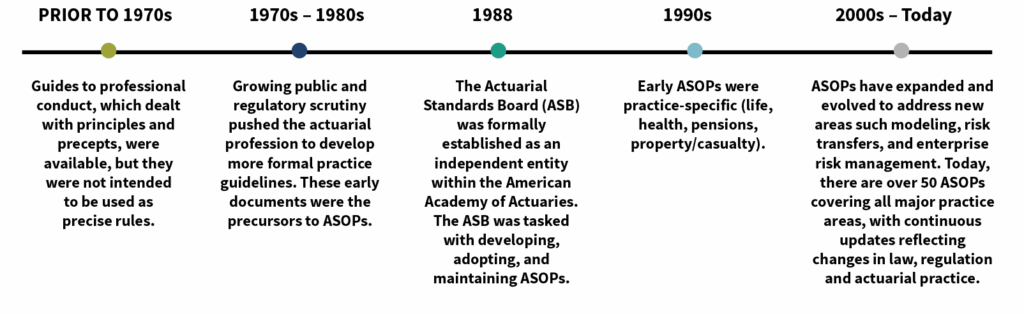
Before the 1970s, actuaries primarily relied on professional judgment and informal guidance from actuarial organizations. As the profession grew into more diverse practice areas and faced increased public and regulatory scrutiny, the need arose for more consistent and disciplined standards.
Figure 1: ASOP timeline
Source: Author
Philosophy of the ASOP
The philosophy behind the ASOP is to set guidelines for what actuaries should consider, do, document and disclose when performing actuarial services. They are not meant to be rigid rules, but rather principles that promote high-quality, transparent and accountable actuarial work. They:
- Provide guidance for appropriate practice, not merely codify current or best practice.
- Are principles-based, not prescriptive, unless required by law or regulation, and never replace professional judgment.
- Allow for ranges of “appropriate practice” and adapt to evolving practice.
- Focus on guidance rather than educational material, with educational content generally included in Appendix 1 if needed to clarify guidance.
- Emphasize disclosure, which serves as the cornerstone of demonstrating compliance with the standards.
- Satisfy regulators and others that the profession can be relied upon to follow appropriate actuarial practice, thereby avoiding the need for legislatures and regulators to set actuarial standards.
A look at the ASOP process
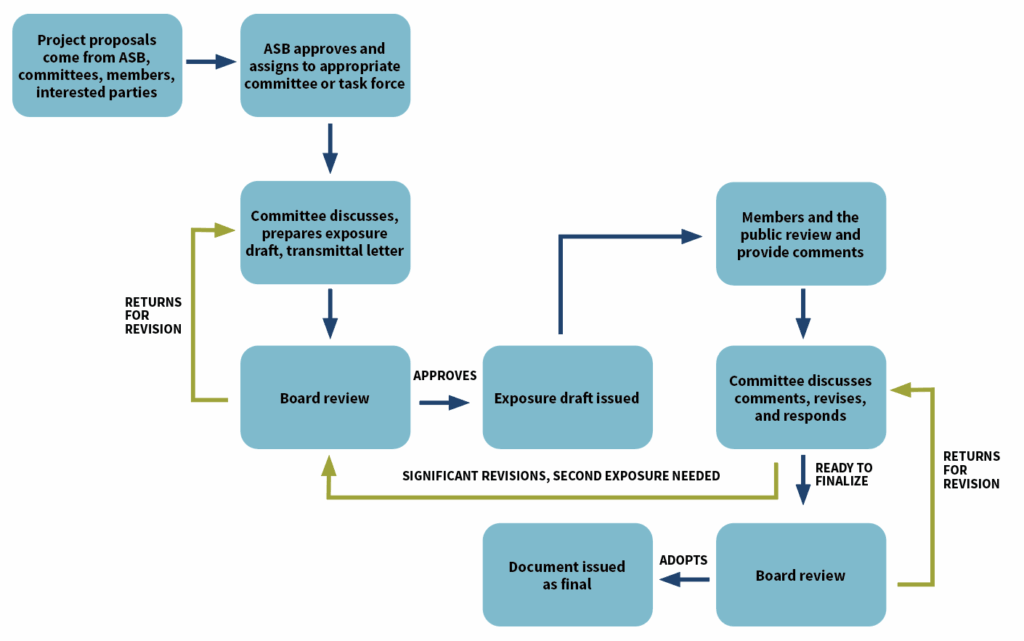
The Actuarial Standards Board follows a deliberative and transparent process in developing, revising and maintaining the ASOP.
- Identification of need. A potential new standard or revision is identified, often due to changes in law, practice or feedback from the profession.
- Proposals for new ASOP or updates to existing ASOP: The ASB accepts proposals for standards or updates from actuaries and other stakeholders.
- Exposure draft. A designated task force may be established comprising actuarial professionals with relevant expertise to prepare drafts of proposed ASOP (or revision). The proposed draft passes through committee review and ASB approval before it is issued publicly as an exposure draft.
- Exposure draft review: During a public comment period, actuaries and other stakeholders may review and provide feedback on proposed standards exposure drafts. Updates and exposure drafts are available on the ASB’s website.
- Public comment. Actuaries, regulators and other stakeholders are invited to provide comments, which are carefully reviewed and considered. There may be multiple iterations of exposure drafts presented for public comment.
- Adoption. After revisions based on feedback, the ASB adopts the ASOP (or revision) and it becomes binding guidance for actuaries within its scope.
This process ensures that standards are created with broad input and reflect both professional consensus and evolving practice.
Figure 2: ASOP process
Source: Actuarial Standards Board
In closing
The development and revision of ASOP involves input from members of the actuarial profession and public stakeholders through different mechanisms.
FOR MORE
Read the definitions from the Actuarial Standards of Practice as updated by the Actuarial Standards Board.
Keep in mind that each actuary is required to complete three hours of professionalism continuing education (CE) annually. According to the American Academy of Actuaries U.S. Qualification Standards, reading and submitting a comment letter to the ASB on an ASOP exposure draft counts towards professionalism credits.
Actuaries taking part in the process can help ensure that the ASB is receiving the types of input it needs from practitioners, and that the ASOP remain relevant, practical, and reflective of high professional standards.
Statements of fact and opinions expressed herein are those of the individual authors and are not necessarily those of the Society of Actuaries or the respective authors’ employers.
Copyright © 2025 by the Society of Actuaries, Chicago, Illinois.