

Beyond the Spreadsheet
How actuarial risk expertise helped Mark Griffin turn curiosity into a creative pursuit
October 2026Shutterstock
For The Actuary’s ongoing “Passions & Personalities” series, I connected with Mark Griffin, FSA, CERA, to discuss how his actuarial career has guided his pursuits as an author and how his experiences might be relatable to others in the profession.
Actuaries are not typically known for their artistic traits. The stereotype says we are very left-brain dominant pencil-pushers, and the extent of our artistry is creating PowerPoint slides (but seriously, who doesn’t love a beautiful, impactful PowerPoint presentation!). Our lack of artistry is obviously a generalization: Actuaries have ventured into music, acting, painting or writing, as examples. For some of us, it’s just a nice pastime. For others, like Mark, it can also be “the crystallization of a diverse set of career experiences.” As an avid reader myself, I was eager to learn about the path that led Mark to write The Mortality Thief. So, I asked him.
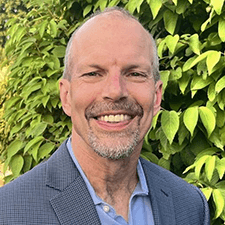
A graduate of the University of Waterloo (Ontario, Canada), Mark’s career started in the finance center of New York. “I took a two-year assignment at Met Life New York, planning to return to their Canadian head office,” Mark told me.
“In New York, I became curious about investments and took a job with Morgan Stanley and then with Goldman Sachs, working in New York and London for both. That led to a number of Chief Risk Officer (CRO) positions at insurers and asset managers. Risk management was a good fit for my inherent curiosity or, some might say, my inability to stop asking questions.”
Right away, I could tell Mark had one of a writer’s defining traits: insatiable curiosity. Still, many actuaries are curious, but not many of us take the leap to write a book, especially a novel. So, I wanted to know whether Mark had any prior writing experience. He mentioned writing some professional articles, but his kids were his first audience for fiction.
“The scope of my London jobs was the world ex-North America, so I did a lot of traveling,” he said. “When my kids were young, I would write them stories about the places I visited. I noticed over time that I could only get their attention if I made the writing more interesting and exciting.”
His actuarial training didn’t go to waste. Mark was able to use some of the skills he developed as a CRO to write his novel. For example, as actuaries, our numbers need to be translated into compelling stories if we want to get our message across. “As a risk manager, you are expected to do a lot of analysis, but you also have to tell stories that hold people’s interest about what can go wrong,” he explained.
And as risk experts, actuaries are used to imagining different possible catastrophic scenarios, which proved highly relevant in writing a novel. “At a high level, writing (in this case, a suspense novel) amounts to picking one of those many scenarios, with disruptions and cross-over impacts, that will keep the pages turning,” he said.
That said, Mark is the first to acknowledge that the path from actuarial training to creative writing is not exactly a well-lit one. “Let’s face it, spending a decade-or-so of your most formative years studying a set curriculum and then working in a rigorous profession, while you may also be trying to balance caring for kids and/or parents, is not a recipe for creativity. If there was a secret passageway between actuarial training and creative writing, there would be a very strong headwind in that narrow tunnel,” he reflected.
“I think creative writing starts with creative thinking,” he continued. “Many will jump to the phrase ‘get out of your comfort zone.’ I think that phrase describes where you should be trying to get to, not how to get there. I believe the ‘How?’ is to stay curious and surround yourself with diversity. Get AI to design a course for you in nanotechnology. The next time you pass a shelf of magazines, close your eyes and grab one. Take an EMT course (another exam, but you are good at exams); jump out of some ambulances with blue latex gloves on. Volunteer for something that will make you very uncomfortable; volunteer for different things until you fail at one. Along the way, you will find something that appeals to you. Hang on to that, even if you can’t nurture it immediately.”
But when did he find the time to write a book? It all started with a lucky scheduling mistake. “Long after I had lived in London, I was back on business and, through a scheduling error, found myself with two days with absolutely nothing to do. No Outlook calendar, no kids to coach or grass to cut. Nothing. Unheard of,” he said.
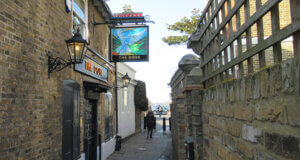
“I wandered out of my hotel, found the PTSD veterans camp (that plays a role in the book), and got on a random bus without having any idea where it was going. I made a random discovery down by the Thames River that took me back to early in my actuarial career. That’s when a bunch of thoughts started to connect, and I stepped into The Dove pub to rehydrate.”
It was at this time that the book plot came faster than Mark could write it down. “Like most actuaries, I like to think of myself as a logical person, but there’s no logical explanation for how it fell together,” he said.
I love how Mark embraced his creative inspiration, and I wondered if publishing the book was as easy as coming up with the idea. “There was some luck there, too,” he said. “I sent the manuscript out in what is referred to as a ‘query letter’ to more than a hundred agents and publishers. I got a bunch of ‘no thanks’ and a bunch of silence.”
“Things were dead in the water for a while,” he added. “I didn’t have anything resembling an author’s profile, no Master of Fine Arts, no book of poetry. Even my reasoning that I had been paid to think about what could go wrong for years didn’t resonate. One small London indie publisher then took enough interest to read the manuscript.”
In the novel’s premise, one thing that resonates is that the main character, a risk analyst, risked everything to prevent data from being misrepresented or suppressed. Something we may take for granted yet sets us apart as professionals. Mark credits his career path for shaping a sense of professional purpose. “I was fortunate to live outside North America, to travel extensively and to work outside the insurance industry,” he said. “I found myself in many uncomfortable situations.” It’s a thread that runs through both his career and his advice to other actuaries: The best opportunity for creativity often happens outside familiar territory.
Mark is working on a second novel that is related to his actuarial work. “Climate risk and the transition to a green economy are my passions. I am a mentor and coach in a climate tech accelerator,” he said, noting that the second book involves climate tech and is mainly set in northern Manitoba.
MORE ON ACTUARIAL AUTHORS
Read The Actuary article, “Living on Purpose.”
Talking to Mark, it’s hard not to feel a quiet pride in what the actuarial toolkit (curiosity, scenario thinking, storytelling, comfort with uncertainty) can produce when it’s turned loose on the world beyond the spreadsheet.
His work as a writer is a reminder that actuaries have more to offer creatively than stylized PowerPoint slides. We may not all have two free days in London and a pub by the Thames waiting for us, but Mark’s story shows that our artistic side is never far from the surface.
Statements of fact and opinions expressed herein are those of the individual authors and are not necessarily those of the Society of Actuaries or the respective authors’ employers.
Copyright © 2026 by the Society of Actuaries, Chicago, Illinois.