

Teddy’s Takeaway
The inspiring actuarial journey of Marc-Edouard Kernisant, FSA, FCIA
February 2026As we celebrate Black History Month, stories of resilience, determination, and trailblazing success speak louder when they come from within our own communities. Marc-Edouard “Teddy” Kernisant’s journey to becoming a Fellow of the Society of Actuaries (FSA) and a Fellow of the Canadian Institute of Actuaries (FCIA) is one such story, demonstrating that the journey does not have to be perfect; success comes in different shapes and forms.
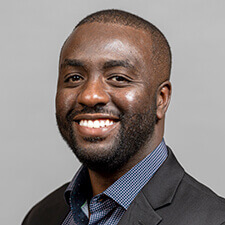
Teddy’s journey to becoming a Fellow was far from easy. “I was not the best student when I was in university,” he shared honestly as we started our interview. His actuarial studies began at Concordia University in Montreal, where we both met as aspiring actuaries. Balancing a full course load, a part-time job, and participating actively in his church choir and youth groups, Teddy struggled to find his footing in this new academic setting. The workload overwhelmed him. “My initial year at Concordia was a disaster. I failed out of the actuarial program,” he said.
For many, such a setback might have ended their actuarial aspirations. But Teddy’s story is one of perseverance. Facing the reality of failure, he decided to give himself a second chance. He transferred to the Université de Montréal, and this is where he found his university footing. “To think that somebody could fail out of the program at the start of their journey and just make it all the way to getting their FSA … that was quite the accomplishment that I was personally really proud of,” he said.
His transparency about struggles struck a chord when he shared his story on LinkedIn after obtaining his FSA designation in March of 2025. “The reaction was overwhelming,” he said. “I was really pleasantly surprised with the amount of people that resonated with my post and basically my story.” Teddy’s takeaway was clear: With enough determination, enough perseverance, you can get there as well.
LEARNING THE ROPES
Thinking of what might have led to his initial struggles at University, Teddy realizes he faced the compounding challenge of transitioning from the French educational system at Collège Stanislas, where he had spent all his school years prior to attending Concordia University. He was accustomed to a school environment where students were told exactly what to do. He then found himself in an English-speaking university setting that demanded more self-directed study. “I went to Concordia, waiting for teachers to give me homework to study,” he said. “I just wasn’t in the right mindset that I needed to be in, in order to succeed in that program.”
Yet, Teddy’s commitment to actuarial science never wavered. “I just didn’t know what else I wanted to do,” he said. “Math was the only option left by default.” Coming from a Haitian family that valued prestigious careers—his father a doctor, his brother an engineer and his sister a lawyer—Teddy felt both pressure and motivation. “Education and demanding careers were important in my family,” he added.
After graduating from Université de Montréal in 2008 with two preliminary exams passed, Teddy’s career began in group underwriting at Sun Life, a role he took without fully understanding it, but which aligned with his actuarial ambitions. “The director was actually an actuary who had the ASA designation,” he said. “So, I figured, ‘Okay, that job makes sense for me.’”
Balancing work, family and exams was no easy feat. Teddy earned his ASA in August 2013, the very day he got married. “My wife was very supportive and helped me get through these exams,” he said. “We used to joke that both our names should be on the Fellowship certificate.”
The road to Fellowship was long and filled with setbacks. It took Teddy nine attempts to pass his three FSA-level exams. “It was trial and error; just going back and trying again, trying again.” He recalls moments of doubt, wondering if the sacrifices were worth it, especially with two young daughters at home. Yet, the desire to break new ground kept him going. “I couldn’t find a Black actuary in Montreal more senior than me who held the FSA designation,” he said. “(I thought) maybe finishing those exams will be the motivation some future young Black actuary needs to keep pushing.”
Teddy’s story is not just about personal achievement but about representation and paving the way for others. “I was able to share my journey in webinars hosted by the Society of Actuaries,” he said. “It’s very easy to look at a LinkedIn profile and think it must have been easy for them. The reality was no, it took quite a few fails and wasn’t always easy.”
Today, Teddy thrives in a leadership role at Desjardins, where he manages group underwriting and enjoys mentoring others. He is also part of the inaugural cohort of the International Association of Black Actuaries (IABA) Emerging Leaders program, designed to help Black actuaries advance to senior leadership roles. “Having senior leaders share their strategies is priceless,” he said. “I encourage young Black actuaries to get mentors and invest in those relationships. It will tremendously impact your career.”
FOR MORE
Read The Actuary Canada article, “Inspiring the Next Generation of Actuaries.”
View “Answers from an Actuary,” featuring Marc-Edouard “Teddy” Kernisant, on the SOA’s YouTube channel.
Teddy’s journey reminds me that success in actuarial science is not just about intellect or talent, but about resilience, support and having the courage to keep going when the path is sinuous. As he puts it, “Iron sharpens iron. Being in contact with leaders and seeing other Black actuaries doing wonderful things inspires me to do my part and keep pushing. If my career can blossom, it helps my family and also gives younger actuaries someone to look up to. It’s a win-win all around.”
This Black History Month, Teddy’s story stands as a beacon of hope and a call to action—to support, mentor, and celebrate the diverse talents that enrich our profession and our communities.
Statements of fact and opinions expressed herein are those of the individual authors and are not necessarily those of the Society of Actuaries or the respective authors’ employers.
Copyright © 2026 by the Society of Actuaries, Chicago, Illinois.